

When Stevie Played the Room: A Sixth Street Story from Maggie Mae’s
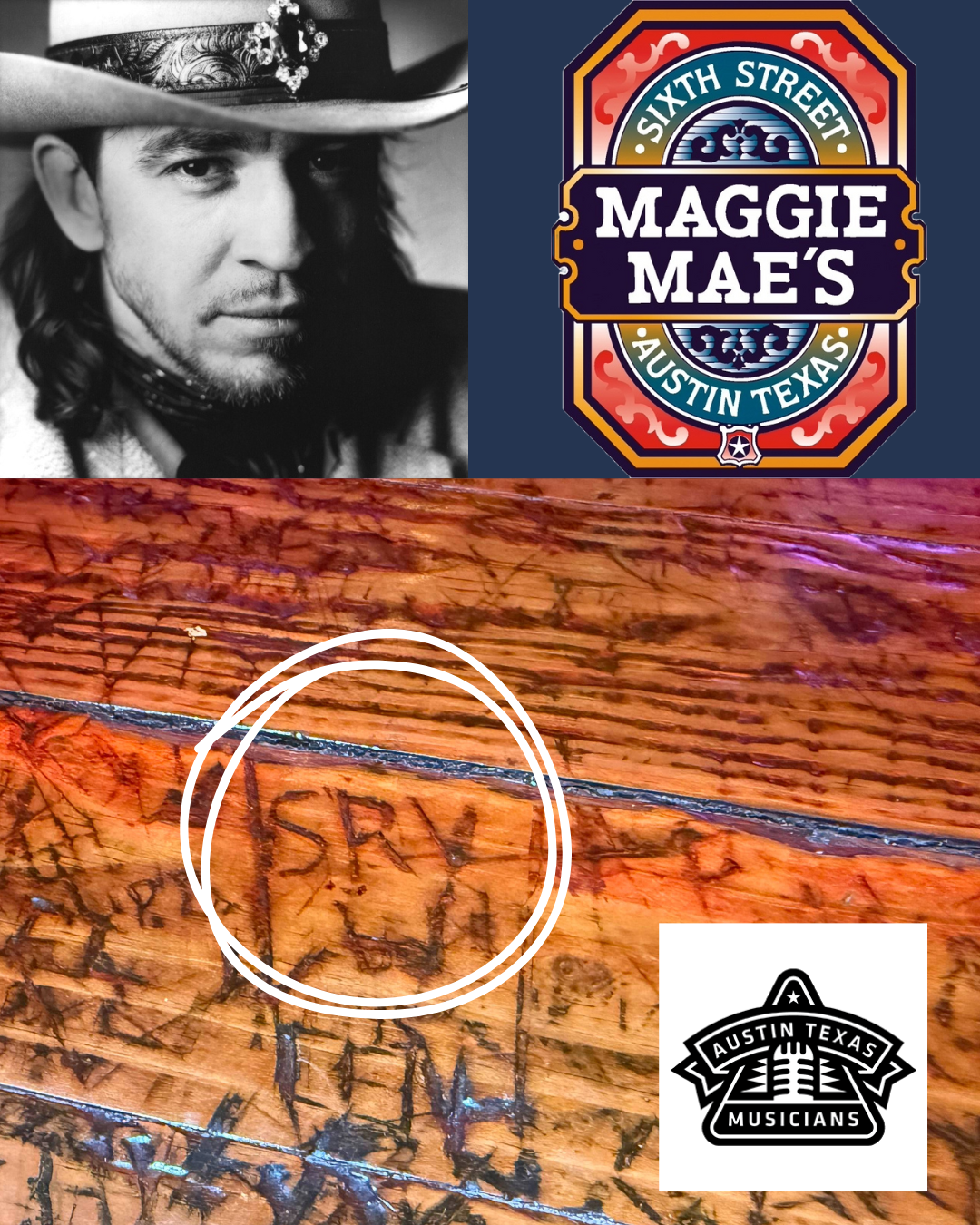
Stevie Ray Vaughn’s initials carved in the downstairs (left) bar at Maggie Mae’s on Sixth Street.
Before Stevie Ray Vaughan was a global guitar legend—before the Grammys, before the world tours, before Austin painted him into its skyline—he was a young, hungry musician carving his sound out of Texas air thick with heat, whiskey, and possibility. And some of that grit, sweat, and electricity lived right there on East Sixth Street, inside a little club called Maggie Mae’s.
In the late 1970s and early 80s, Sixth Street was a different beast. It wasn’t the neon carnival it would later become. It was raw, a little dangerous, and absolutely alive with music. Stevie could be found drifting between the street’s handful of scrappy venues, guitar in hand, usually wearing a wide-brimmed hat that looked too big for a kid from Oak Cliff—until he started to play. Then everything fit perfectly.
Maggie Mae’s, already becoming one of Sixth Street’s reliable music houses, offered a stage where anything could happen. And when Stevie played there, everything did.
The Sound That Took Over the Room
People still tell stories about those nights—the way he’d plug in a beat-up Stratocaster, take a quiet breath, and then unleash something that felt like both a prayer and an explosion. The band would be tight, always. The room would be packed, always. The crowd didn’t just listen; they leaned forward as if the music pulled gravity toward the stage.
He had this incredible mix of precision and chaos, control and abandon. His solos weren’t just licks—they were confessions, and the walls of Maggie Mae’s soaked them up, adding one more layer to the building’s already rich musical soul.
If you were lucky enough to catch him there, you remember the moment he launched into “Texas Flood.” The whole bar changed shape. Time slowed down. Conversations stopped mid-sentence. The bartenders forgot to pour. The sound was bigger than the PA system, bigger than the room—honestly, bigger than Sixth Street itself.
A Place Where Legends Learned to Fly
Before the world claimed him, Austin claimed him. And Maggie Mae’s is one of those places where the legend grew its wings.
He wasn’t famous yet—not really. But everyone on the block knew. They felt it. When he played, other guitar players gathered at the back of the room not to compete, but to witness. To learn. To understand that the sky had shifted and they were all standing under a new weather system named Stevie Ray Vaughan.
Sixth Street gave him a home. Maggie Mae’s gave him a stage. Austin gave him a future.
The Echo That Still Lives There
Today, as musicians load in gear up the same stairs he once climbed, you can still feel that echo. Austin’s music scene is built on thousands of nights like those—nights when a kid with a dream and a guitar changed the trajectory of a city.
Stevie outgrew Sixth Street, but Sixth Street never outgrew Stevie. His spirit is woven into the floorboards, the brick, the air. And every time a new musician steps onto that stage, they inherit a little piece of that history.
Because Maggie Mae’s isn’t just a bar.
It’s a chapter in the story of Austin music.
And Stevie Ray Vaughan helped write it.