
Congressman Greg Casar Partners with Austin Texas Musicians to Advance AI Protections for Independent Artists
Generative AI training models currently steal the intellectual property of musicians without consent, credit, or compensation.
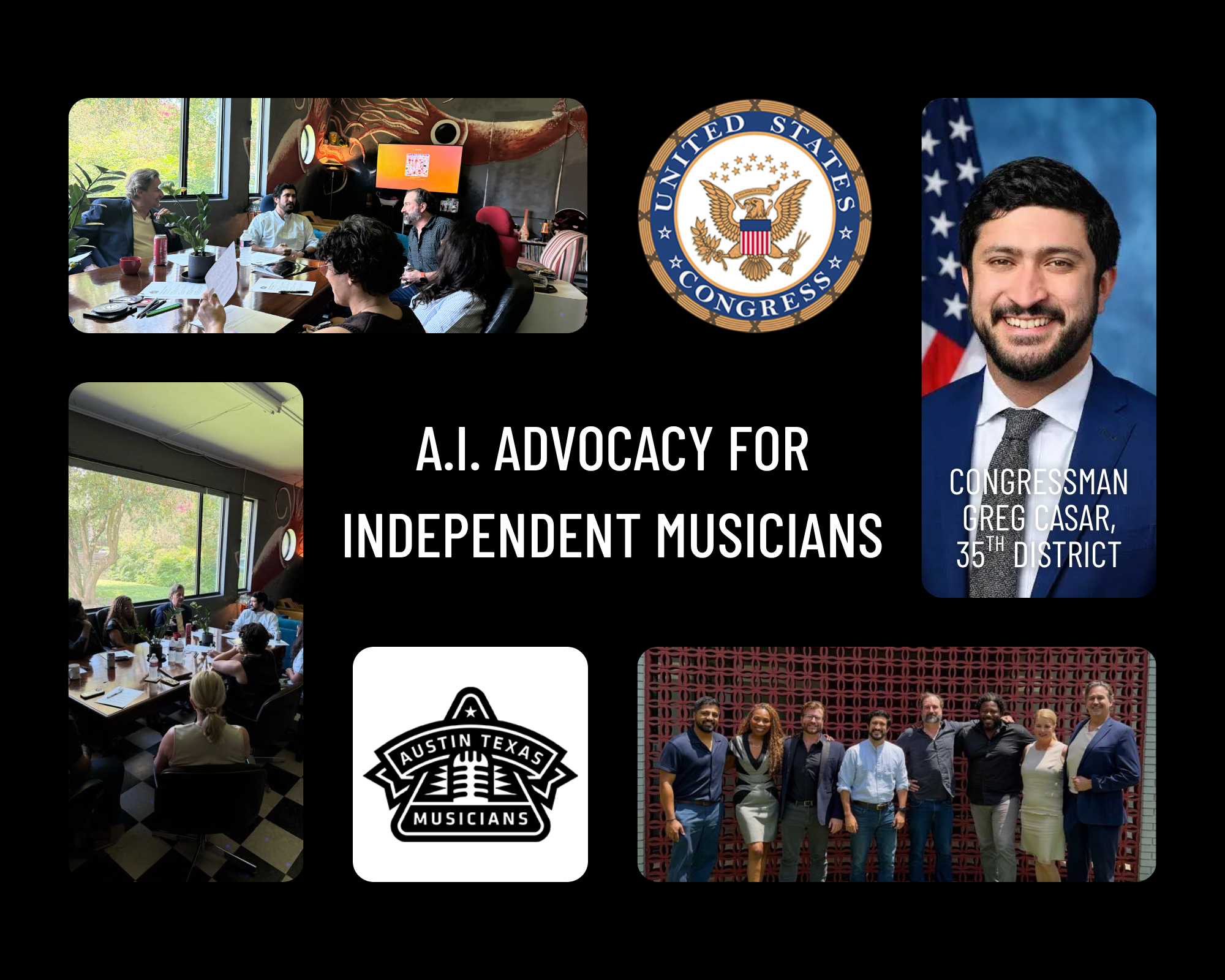
After our AI vs. Music Panel/Protest at The Far Out Lounge several weeks ago with partners Prosper XO, We Need a Union, and the MWA • Music Workers Alliance, Congressman Greg Casar reached out to request a meeting to learn more about the issue.
Our team was honored to meet with the Congressman this Tuesday (June 16, 2026) at Same Sky Productions, and I’m happy to announce that we will be working closely together to raise public awareness and advance legislative efforts to protect our vital working-class musicians. We’re very appreciative and look forward to working on this very important initiative at the local, state and federal levels!
Context
As artificial intelligence rapidly transforms the music industry, Austin Texas Musicians (ATXM) is taking an active role in ensuring that musicians, songwriters, and creators have a seat at the table.
On Tuesday, June 16, Austin Texas Musicians (ATXM) met with Congressman Greg Casar, members of his district team, independent musicians, producers, and music industry professionals to discuss the growing impact of artificial intelligence on creators and the urgent need for policies that protect artists while supporting responsible innovation.
The discussion centered on emerging concerns facing artists across the country, including unauthorized voice cloning, AI-generated artist replicas, copyright protections, compensation for the use of creative works in AI training models, and the long-term economic sustainability of working musicians.
Meeting Participants
The meeting brought together a diverse group of advocates, musicians, and industry professionals committed to protecting creators' rights in the age of artificial intelligence.
Austin Texas Musicians (ATXM)
Pat Buchta – Executive Director, Austin Texas Musicians; Independent Musician
Mary McKeown-Christie – Chief Marketing Officer, Austin Texas Musicians
Office of Congressman Greg Casar
Congressman Greg Casar – U.S. Representative, Texas's 35th Congressional District
Diana Gomez – District Director
Katie Marschner – Constituent Advocate
Independent Musicians & Industry Representatives
David Madden – Independent Musician, Dave Madden Music
David Messier – Owner & Producer, Same Sky Productions
Adi Rao – Independent Musician, Adi Vocals
Courtney Santana – Independent Musician, Courtney Santana Music
Scott Strickland – Independent Musician; Owner, Strick Media Group and Stricknyne Studios
The meeting provided an opportunity for working musicians and industry professionals to share firsthand concerns about AI-generated content, voice cloning, copyright protections, compensation, artist identity, and the long-term economic impact of artificial intelligence on creative careers.
Why This Matters
Artificial intelligence is already being used to generate music, replicate voices, imitate artistic styles, and train commercial systems using vast amounts of human-created content. While these technologies offer exciting opportunities, they also raise significant questions about ownership, consent, transparency, and fair compensation.
For independent musicians, the stakes are particularly high.
Without clear guardrails, artists risk losing control over how their music, performances, likenesses, and creative identities are used. Many creators are concerned that AI systems may derive substantial commercial value from their work without permission, attribution, or compensation.
ATXM believes innovation and creator protection can coexist—but only if artists are included in the policymaking process.
ATXM's AI Policy Framework
During the meeting, ATXM shared key recommendations outlined in its recently released AI Policy White Paper. The organization advocates for future AI legislation and industry standards to be built upon four foundational principles:
Consent
Creators should have the right to determine whether their music, recordings, performances, likenesses, or voices may be used to train AI systems.
Compensation
Artists should receive fair compensation when their creative works contribute value to commercial AI products and services.
Transparency
Technology companies should clearly disclose when AI systems have been trained using copyrighted materials and when AI-generated content is being presented to consumers.
Accountability
Organizations developing and deploying AI technologies must be responsible for preventing misuse, unauthorized replication, and harm to creators.
These principles align with recommendations outlined in ATXM's AI Policy White Paper, which also advocates for consent-based AI training, protection of voice and likeness rights, disclosure requirements, and support for human creativity.
Austin's Opportunity to Lead
As the Live Music Capital of the World, Austin has long been at the forefront of supporting musicians and creative professionals. ATXM believes Austin has an opportunity to help shape the national conversation around ethical AI, creator rights, and equitable innovation.
The meeting with Congressman Casar represents an important step in ensuring that the voices of working musicians are heard as policymakers consider future legislation and regulatory frameworks.
"ATXM's goal is not to stop innovation. Our goal is to make sure innovation happens responsibly, with musicians and creators protected rather than exploited."
What's Next
ATXM remains committed to collaborating with artists, attorneys, policymakers, technology leaders, industry organizations, and community partners to advance several key initiatives:
Advocating for legislative change at the local, state, and federal levels to protect musicians and independent artists from unauthorized use of their work, voice, likeness, and creative identity.
Pursuing accountability for organizations and technology platforms that improperly associate artist names, identities, and reputations with AI-generated content, creating confusion in the marketplace and potential damage to artist brands.
Exploring the development of class action legal strategies on behalf of musicians whose work, names, or likenesses have been used without permission or compensation.
Establishing a legal defense coalition that includes personal injury, intellectual property, entertainment, and class action attorneys willing to help defend artists and pursue compensation when harm occurs.
Building public awareness around these issues through advocacy, education, and community organizing.
Integrating this work into our upcoming "Stand With The Band" campaign, a broader initiative focused on protecting independent artists, preserving human creativity, and creating a sustainable future for musicians.
As outlined in Austin Texas Musicians' AI policy recommendations, future AI policy must be built on four core principles: Consent, Compensation, Transparency, and Accountability.
This is not simply a music industry issue. It is a creator rights issue. It is an economic issue. It is a cultural issue. And it is a defining moment for the future of human creativity.
The future of music should include innovation—but it must also respect the people whose creativity makes innovation possible.
Together, we can build an AI future that values both technological advancement and the rights of creators.
Learn More
Read the Austin Texas Musicians AI Policy White Paper and learn how you can support efforts to protect musicians in the age of artificial intelligence.